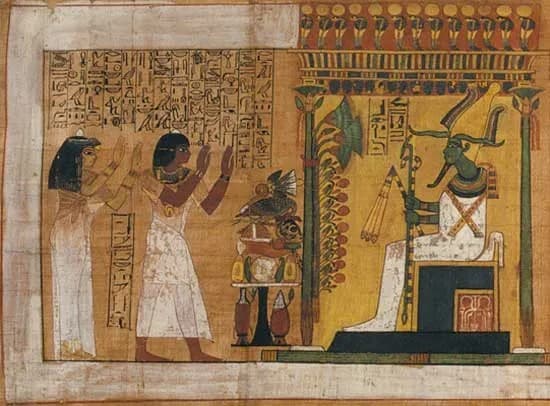
The Book of the Dead is a compilation of some of the earliest and most significant religious writings from ancient Egypt. It was a decorated papyrus scroll placed in the tomb to serve as a roadmap for the departed through his perilous journey through the NETHERWORLD. Some of the manuscripts were 4,000 years old when Jesus was alive and came from the Pre-dynastic era in Egypt. The Book of the Dead is not a book in the traditional sense; rather, it is a collection of rolls of papyrus that the priests of ancient Egypt used to record spells, incantations, prayers, hymns, and rites. About 200 distinct spells have been assigned chapter numbers in the various editions of the Book of the Dead, so, for example, any magic dealing with "the heart not opposing the deceased" would be found in Chapter 30.
The Book of the Dead evolved from the PYRAMID TEXTS and COFFIN TEXTS. While the Pyramid Texts were magical spells for the pharaohs only, the Coffin Texts could be used by anyone who could afford to have a coffin carved or painted with magical inscriptions. Eventually, there were too many spells to fit on the coffin, and the Book of the Dead was the answer to the problem. Now all magical spells could accompany the deceased, for they could be written on papyrus and placed in the tomb with the mummy.
Scribes filled papyrus rolls with spells for protection and instructions on how to behave and make the bodywork again in the next world. Generally, the Book of the Dead had four sections:
(1) how to protect the body in the tomb.
(2) how to make the journey to the Netherworld.
(3) how to pass the judgment of the gods.
(4) how to exist in the next world after being accepted by the gods.

About 200 different spells or chapters appear in the Book of the Dead, but they appear in no fixed order. Books written in the north or the south of Egypt had a particular style. The actual title of the Book of the Dead is "The going forth by day," which might refer to the deceased going forth to the Netherworld. The Egyptians feared the night, and it would have been considered an advantage to make the journey during the day. Whatever the title meant, it undoubtedly was a reference to death. The ancient Egyptians did not mention death directly but had many euphemisms or names for death and the deceased. For example, because the west bank of the Nile was associated with death (the sun died there every day, and the dead were buried in cemeteries on the west side), if someone died, it was said that he "went west." The dead were called "Westerners" or "True of Voice."
Many Theban versions of the Book of the Dead contain hymns to the gods, especially to OSIRIS, the god of the dead. An abbreviated example of the melody to Osiris, from the papyrus of Ani (a scribe in the Eighteenth Dynasty) reads:
Adoration of Re when he appears on the eastern horizon of the Sky.
Behold Osiris, the scribe of the divine offerings of all the gods Ani, He says, praise to thee who has come as Kheperi, the god of existence, the creator of the gods. May he give pleasure and power as one who is dead. The living soul [of Ani] goes forth to see Horus of the two horizons, the soul of Osiris, the scribe of Ani, true of voice before Osiris...
This hymn of praise to Osiris mentions two essential features of the deceased: the BA, which has been translated as "soul," and the KA, which was a kind of spiritual double. The Egyptians believed a person had five elements: the physical body, the shadow, the name, and, most importantly, the ba. The ka ba was represented as a bird with the head of the deceased, and it seemed to come into separate existence only after the person died. The ba was essential for the dead's presence in the Netherworld.
In an excerpt from the Book of the Dead, The ka was a kind of abstract double of the deceased that needed a place to live. Its first choice was the corpse, but if the body was damaged or destroyed, many Egyptians were buried with one or more ka statues carved in their likeness so the ka could dwell within the statue.
The Egyptians were almost encyclopedic in their concern with the various parts of the body. The Book of the Dead seems to have been written by priests who drew up a list of every body part that would be needed in the next world and then created a spell to protect it, as in the following examples:
The Chapter of Not Permitting the Head of a Man to Be Cut Off in the Netherworld.
I am the great one, son of the great one. I am fire, son of fire, whose head was given to him after it was cut off. His head shall not be taken away from him.
When the Book of the Dead first appeared in the New Kingdom, resurrecting in the Nether- the world was considered essential to anyone seeking immortality. This belief in the Book of the Dead continued well into the Greek occupation of Egypt. The texts themselves remained virtually unchanged for more than a thousand years. Undoubtedly, many who purchased copies of the Book of the Dead could not read them, but that was not of great concern. It was essential to have the magical words that would guide them safely to the Netherworld.
To know more about ancient Egyptian history, contact us now and book your dream Egypt tour with us.