Like a rainbow along the Nile, the Nubian village of Aswan is a kaleidoscope of hues and shades, to visit to savor moments of authentic daily life, to immerse yourself in the simplest traditions of a people perhaps little known but still guardians of rich culture and ancient traditions.
That then, do you know who the Nubians are?
It is one of the oldest populations in the world, so much so that its appearance dates back to 5,000 years before the birth of Christ.
The territory they occupy from the beginning is the one that goes from northern Sudan to the southern areas of Egypt, up to Aswan, following the bed of the Nile.
Dark skin, slender and slender bodies that already betray the different origins from the Egyptian people with whom they do not share customs, customs, or even the language, so much so that a speech between Nubians is completely incomprehensible to others.
For years victims of abuse, today constitute a minority that is very fascinating to discover by visiting one of their colorful villages.
I set sail from the port of Aswan in the late afternoon, on a motorboat that cruises the river slowly.
On the right and left, the profiles of the two banks are already beginning to take shape on a sky that presages the approaching sunset, while the notes of an oriental melody give the rhythm to the rocking of the waves.
Nubians are Dark skin, slender and slender bodies that already betray the different origins from the Egyptian people with whom they do not share customs, customs, or even the language, so much so that a speech between Nubians is completely incomprehensible to others.
For years victims of abuse, today constitute a minority that is very fascinating to discover by visiting one of their colorful villages.
I set sail from the port of Aswan in the late afternoon, on a motorboat that cruises the river slowly.
On the right and left, the profiles of the two banks are already beginning to take shape on a sky that presages the approaching sunset, while the notes of an oriental melody give the rhythm to the rocking of the waves.
The earth is hot and the grains stick to us, getting into our clothes, under our nails, and our hair. we scatter here and there, each taking our own desert space, our corner of sunset that, almost like in the cinema, we witness arriving slowly, enjoying every second of light and sparkle, as the sky ignites and the Nile sparkles with thousands of golden specks.
Check out Egypt Excursions, book your Aswan day tour with Your Egypt Tours
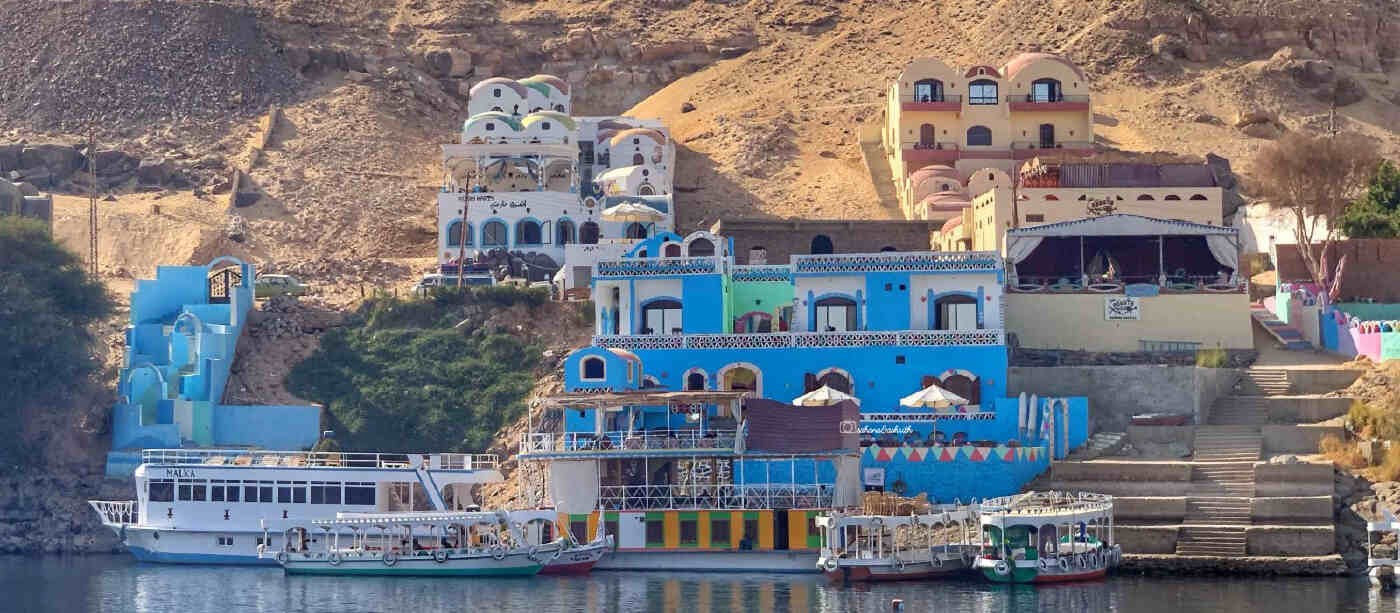
We reach the Nubian village when the evening is now falling.
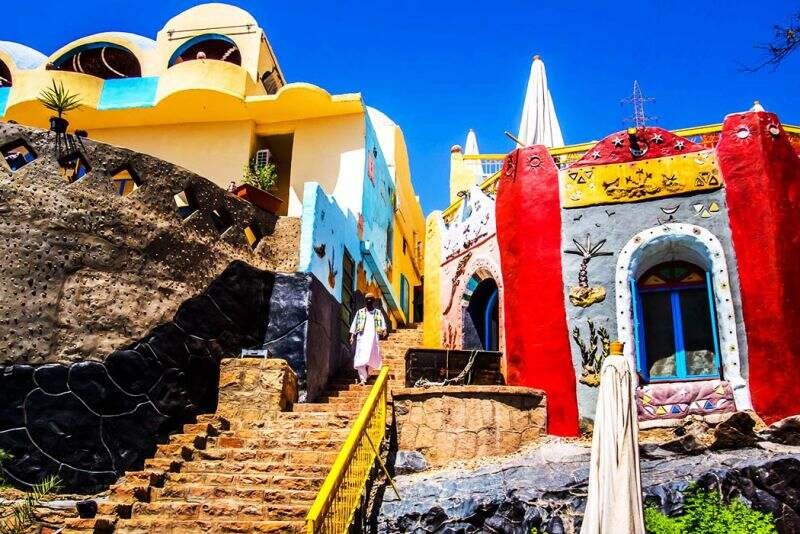
What I encounter, at first glance, I would compare to a pile of colorful Lego bricks, one next to the other, one on top of the other, in combination or contrast.
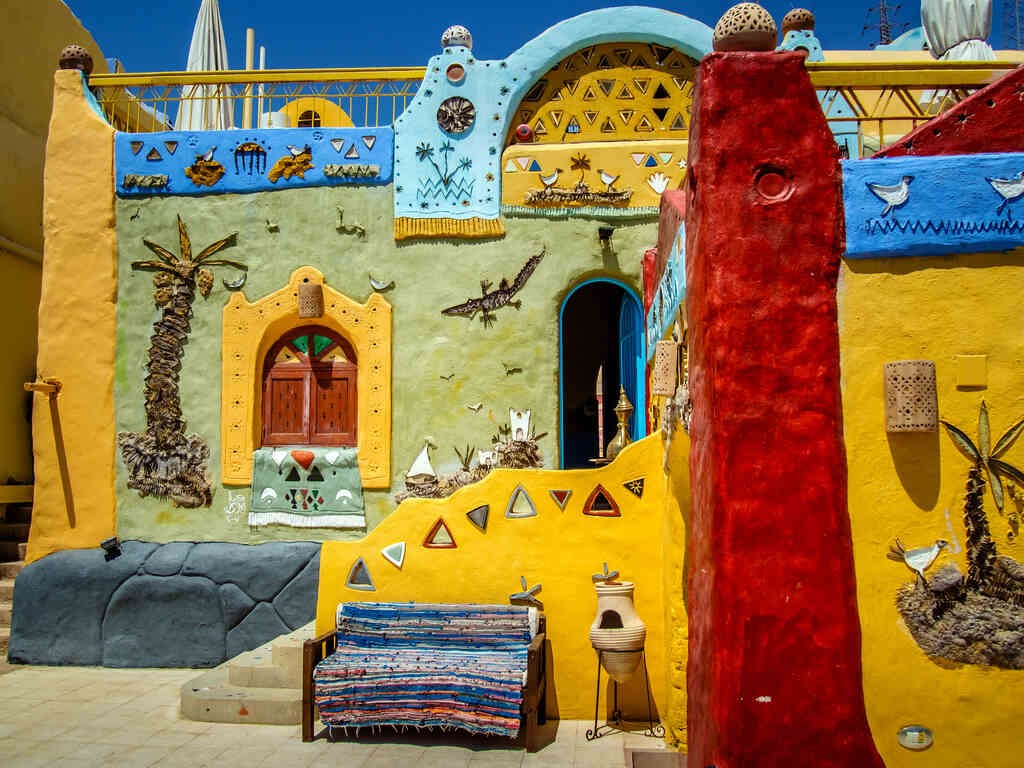
Square huts, blue and yellow, red and green, very rough, with flights of stairs built at the best and masonry arcades.
We wander among the dirt paths, sneaking into the alleys up to the main road, where the shops are still open and the stalls display products of all kinds.
Like 3D paintings, the little shops strike me and kidnap me with their bright colors, like canvases on which an artist has enjoyed pouring the brightest colors of the palette.
Stoles, carpets, jars, and sashes. Bowls filled with spices, jewels, dried fruits, and flowers. The chaos of perfumes, essences, and voices, while the traders draw our attention, pulling us by the arm, inviting us to look and buy.
The Nubian people overwhelm us with all their warmth, showing a great welcome and cordiality.
We are invited to visit a typical house belonging to a local family who proudly opens the doors of their home to us, surrounded by turquoise walls, decorated according to the local taste.
We pass from the entrance to the bedrooms and then browse the kitchen and the atrium, where even alligators are bred in some tanks, as well as any domestic animals.
The children jump around us, among those four spartan rooms that at times reveal certain care, almost an attempt at attention to detail, between a hat hanging on the wall and a collage of carpets on the floor.
Before leaving the Nubian village, we gladly accept a cup of hot karkade, gathered with the family in a bare but clean living room, with uncomfortable seats but a lot of serenity in the air.
THE NUBIAN MUSEUM OF ASWAN
A WONDERFUL COLLECTION OF VERY UNKNOWN FINDS
The Nubian Museum collects a set of objects that tell the story of the development of civilization in the southern Nile valley
Arriving in the spectacular city of Aswan, perhaps sailing on the Nile coming from Luxor, you can visit the Museum of Nubia, a small jewel full of rare and important finds, which offers an enormous contribution to understanding the influence of the Nubian population. in Egyptian history.
Walking through the different rooms, one is enchanted to discover this civilization, which has occupied the area of southern Egypt along the banks of the Nile for millennia and then disappeared almost completely following the construction of the High Dam. It was precisely following the flood resulting from the construction of the dam that the ancient center of Nubia disappeared.
The museum houses truly unique artifacts that start from prehistoric times through the Pharaonic ages, through Christianity and Islam up to the construction of the dam in the 1960s. Some of the most important monuments of Nubia were moved to neighboring areas, such as the temples of Abu Simbel, while others were sent abroad as compensation for aid received such as the temple of Dendur now on display at the Metropolitan Museum in New York. In this small but nice museum, many examples of local art are collected and various moments of Nubian life have been reconstructed. It is really exciting for the visitor to see these scenes of daily life with traditional houses, recovered from areas currently submerged, masterfully reconstructed.
The large statue of Ramses II that dominates the vast hall at the entrance, however, remains the most striking element of the museum with its grandeur and beauty. In addition to the statue, the visitor can admire a splendid gold amphora decorated with stylized Arabic writings which are also represented in an Egyptian banknote. The museum is, therefore, a truly unmissable stop for those arriving in the town of Aswan and being in the vicinity of the Fatimid cemetery, which houses numerous small mausoleums dating back to the 9th century, it offers the opportunity to visit the latter and in the same area also the ancient quarry of granite where the famous and gigantic unfinished obelisk stands.
Egypt with its countless riches and infinite beauties never ceases to amaze and has always retained a charm that manages to excite anyone who comes to visit it.
Looking for Egypt tours and Egypt travel packages including Aswan Sightseeing? contact us Now.