The goddess of cats, Bastet, may have had her beginnings in the Libyan Desert. Because Bastet is affiliated with ISIS she becomes the Soul of Isis, yet as a goddess of music and dancing, Bastet is related with HATHOR The SISTRUM, which they bear as one of their characteristics, is their worship object.
Per-Bast (modern Bubastis), the Delta-based cult city of Bastet, is referred to in the Bible as Pibeseth (Ezekiel 30:17). The name Bastet, which translates as Woman of the Base-Jar or Special Jar, holds Perfume Associated with Her Festivals, is written with the bass jar (bs) and a loaf.
BASTET (BAST) Beloved cat goddess of the Egyptians
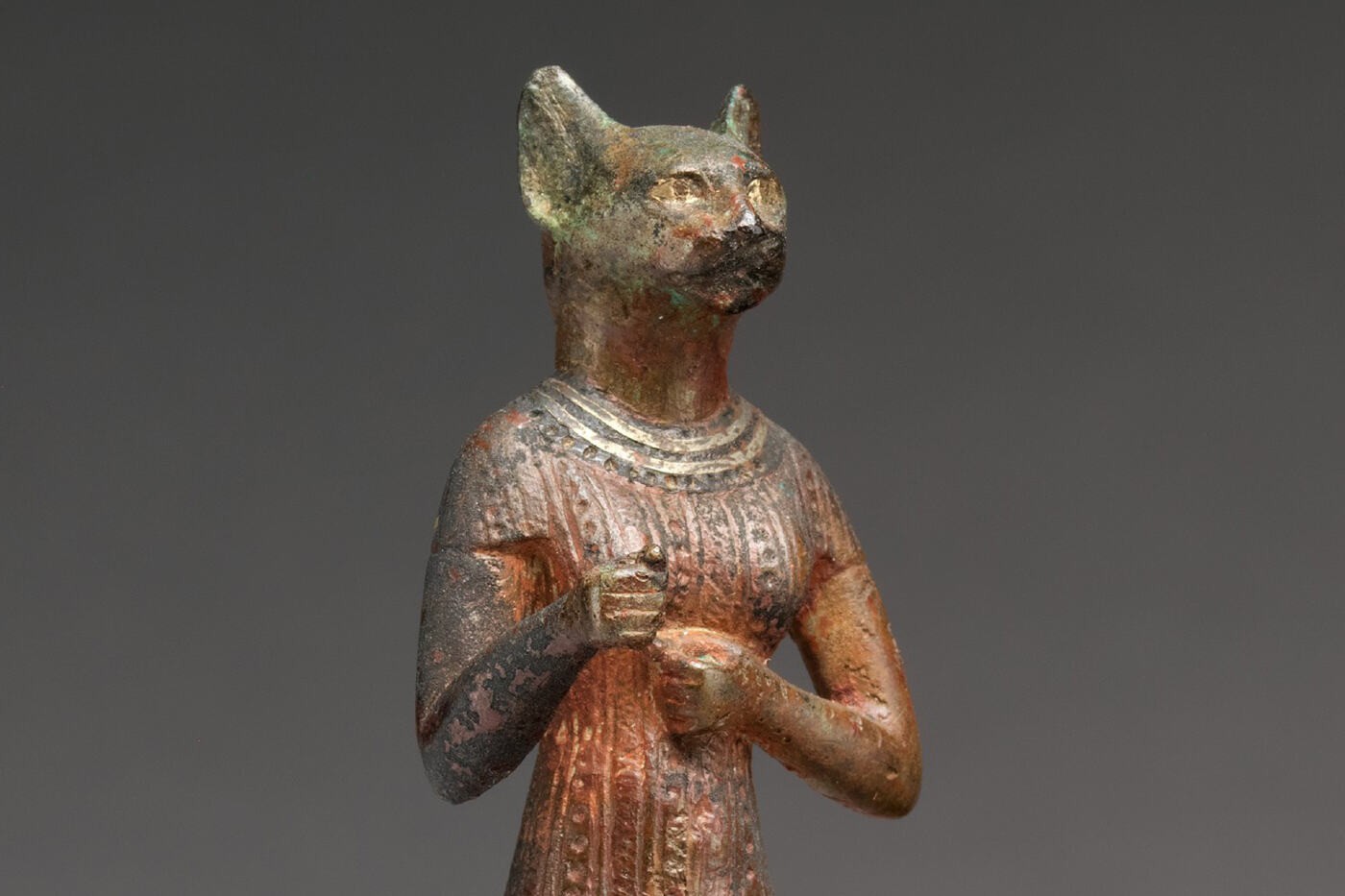
Bastet was referred to as "Goddess of the North" during the Old Kingdom, and in King UNAS's Pyramid Texts, she serves as the king's mother and nurse. Bastet took up the role of Lady of the East when SEKHMET, the lion goddess, was designated Lady of the West. Bastet is shown in early artwork as having a lion's head and being related to the goddess MUT, who also has a lion's head. She is claimed to be PTAH's wife and the mother of the lion-headed god MATHES.
Similar to Sekhmet, Bastet is capable of being both sweet and violent. Her connection to Sekhmet exposes Bastet's vindictive and violent nature. According to one interpretation of the narrative, Bastet is the sun god Re's daughter who, when asked to defend her father, transforms into a raging storm.
The most popular way to depict the feline goddess Bastet is as a cat-headed lady with a sistrum and an aegis. Bastet became a well-known home goddess because cats were common household pets in ancient Egypt. The eye of Re (Pat Remler photograph). She obeyed Re's commands as a responsible daughter and served as the vehicle for her father's retribution.
By the conclusion of the NEW KINGDOM (1550–1069 B.C), Bastet had established herself as a well-liked domestic goddess. As the goddess of the hearth and the protection of expectant mothers, Egyptian households welcomed her into their homes. She was referred to as the goddess of abundance and mistress of pleasure, and her festivals were well-known. As Bastet's fame spread, her religion gained notoriety for its opulent celebrations, some of which were known as the Procession of Bastet, Bastet Protects the Two Lands, Bastet Goes Forth from Per-Bast (her city), Bastet Appears before Re, and the Festival of Hathor and Bastet. These happy events included days of dancing, music, and fun all around Egypt.
When they travelled to the Festival of Bastet, the followers of the goddess are vividly described by the Greek historian Herodotus. Men and women ride together, and there are numerous people of both sexes in each boat, as the Egyptians journey to Bubastis, [the city]. During the entire voyage, some of the ladies shake holy rattles (sistrum, pl. sistra), and some of the men play pipes, while others sing and clap their hands. Some of the ladies yell and clap at the local women as they travel through towns, while others dance and cause a commotion. Every village on the Nile practises this. They start the holiday with significant sacrifices when they get to Bubastis, and more wine is drank during this celebration than at any other time of the year.
The Histories, Book II, Chapter 60 of Herodotus
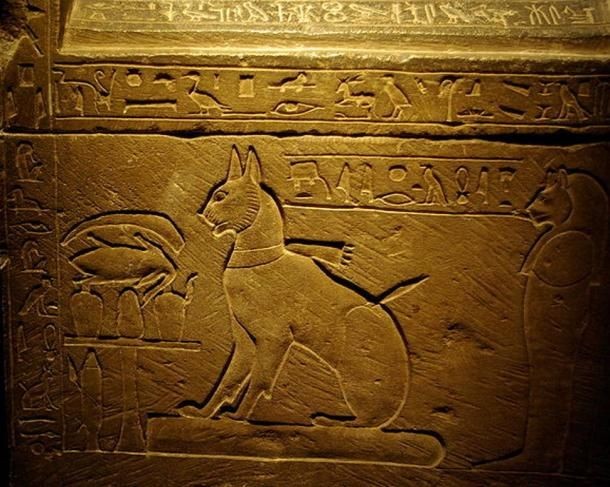
The worshippers marched up to the temple, chanting and playing tambourines and drums. Others danced through the streets while carrying sistra, or religious rattles. The opulent temple of Bastet, according to Herodotus, was situated in the middle of the city on a high area, making it easily visible from all directions. Around the shrine was a TEMENOS wall with numerous animals painted on it. A tree grove was erected in the interior courtyard.
Bastet was so well-known that the Greeks linked her to their own goddess Artemis. Ovid, a third-century Roman poet, claimed that the goddess Bastet could transform herself into a cat and makes reference to her in his work Metamorphoses. Bastet was most frequently shown as having a cat's head and a woman's body and donning a long, tight sheath-style garment with large decorative bands over the shoulders. In addition to her sistrum, the goddess is holding an AEGIS, a talisman that looks like a wide collar necklace with a cat's head, in her other hand. She is occasionally seen holding kittens at her feet, adding to the idea that she is associated with love and family.
A new term, pronounced meow, the sound a cat makes, was used in ancient Egypt to describe kittens. Children were referred to as now-Sheri, small cat, and it evolved into a name of love. Visitors came to Bastet's temple from all across Egypt to make tributes to the goddess. They left amulets, mummified cats, and bronze figurines since the cat was devoted to Bastet. In the location of Bastet's temple at Bubastis, underground crypts containing thousands of cat mummies have been found.