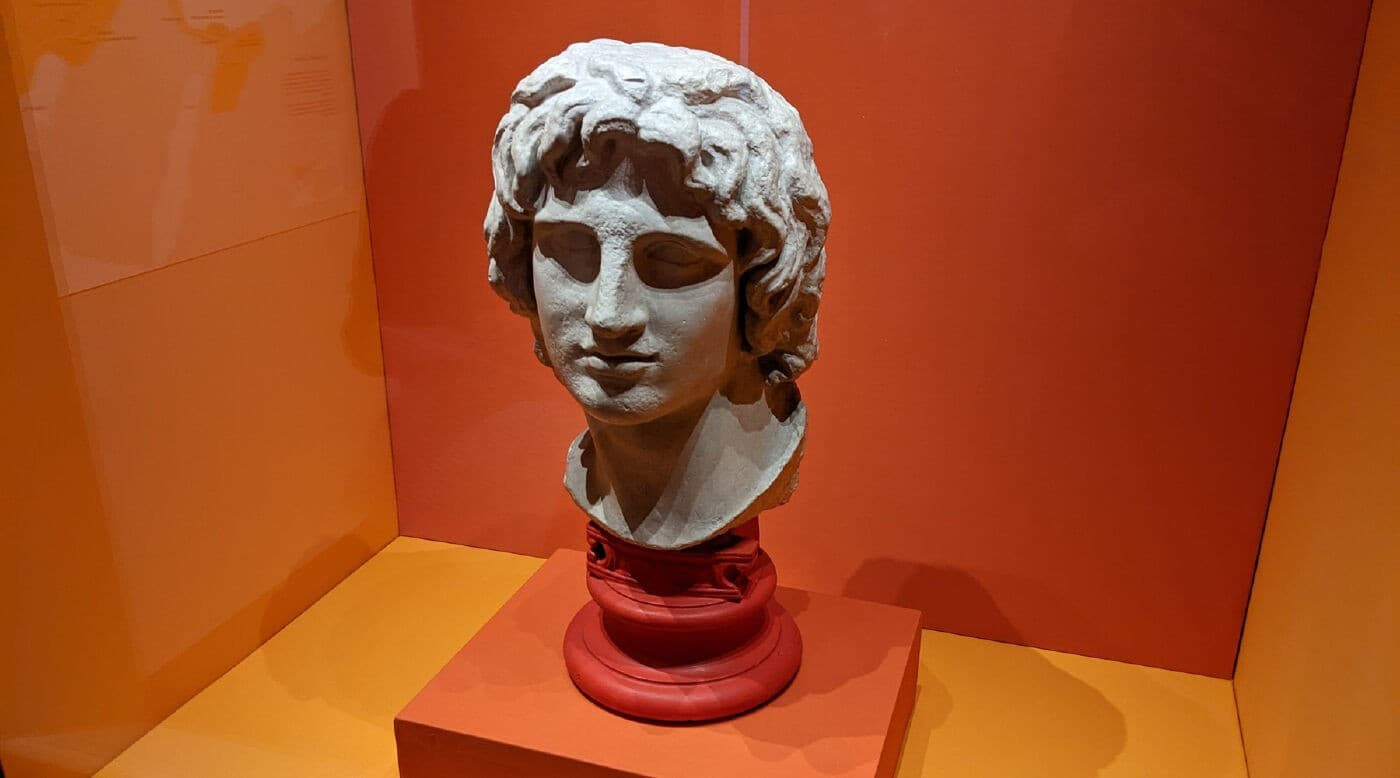
THE GREAT ALEXANDER (352 - 323 B.C)

Alexander the Great altered the course of history even though he ruled ancient Macedonia for less than 13 years. He established a massive empire that spanned from Greece to a portion of India and from Macedonia to Egypt, making him one of history's greatest military leaders.
Egypt was subdued by him in 332 B.C. Alexander succeeded to the throne of Macedon, a tiny Greek kingdom, following the demise of his father Philip II. He unified the Greek nations within a few years, and he and his army of loyal soldiers also took control of most of western Asia and the Levant. The Egyptians praised Alexander as a liberator after he and his troops invaded Egypt and drove out the despised Persians who had been occupying the country. Alexander presented sacrifices to the Egyptian gods in the temples at MEMPHIS, KARNAK, and LUXOR as well as the Siwa Oasis, always respectful of local traditions. In order to be recognised as the progenitor of Amun, the principal god of the Egyptians, he constructed the temple of the Oracle in a lovely oasis in the Western desert.
According to legend, when Alexander and his troops were lost during the arduous march across the western desert, a flock of crows emerged in the sky and guided them safely to the oasis.
Alexander just had one inquiry for the Oracle of AMUN-RE (also known as ZEUS-AMUN by the Greeks): "Who is my father?" When the Oracle responded "Amun" Alexander knew he would reign. Alexander, like all previous Egyptian monarchs, was proclaimed king of Egypt and acknowledged as the son of Amun and a divinity on Earth with the support of the Oracle. The religion and culture of Egypt were appreciated by Alexander the Great. He made a donation to the Egyptian temples as a sign of respect for the Egyptian gods.
Capital city of Alexander, Alexandria

On the location of a tiny fishing community called Rhakotis (Raqote) on the Egyptian Mediterranean coast, Alexander constructed his capital city, Alexandria, in 331 B.C Based on the Greek city style, Alexandria had a grid layout that was exposed to the cool Mediterranean winds. After Alexander's passing, the city was finished, and it expanded to become a prosperous international port with a population of more than 500,000. The Pharos Lighthouse, which was named one of the Seven Wonders of the Ancient World by a Greek librarian, was the most well-known structure in ancient Alexandria. There isn't much of the old construction left anymore. The library of ancient Alexandria, which housed a magnificent collection of papyrus scrolls, was another well-known monument. When Julius Caesar invaded Egypt to resolve a dispute between CLEOPATRA VII and her brother Ptolemy XIII, the library, according to legend, was set ablaze.
Alexander never visited his hometown because he was too busy advancing the Persian Empire. Alexander, who once dreamed of governing as a living god, passed away from a fever in Babylon in 323 B.C. When his generals asked him on his deathbed who should follow him, he replied simply, "The strongest," notwithstanding his aspirations. The generals eventually split Alexander's realm among themselves. The Ptolemaic dynasty was founded in Egypt thanks to General Ptolemy's decision. When Cleopatra VII committed suicide and the Roman Empire ruled Egypt, his dynasty came to an end.