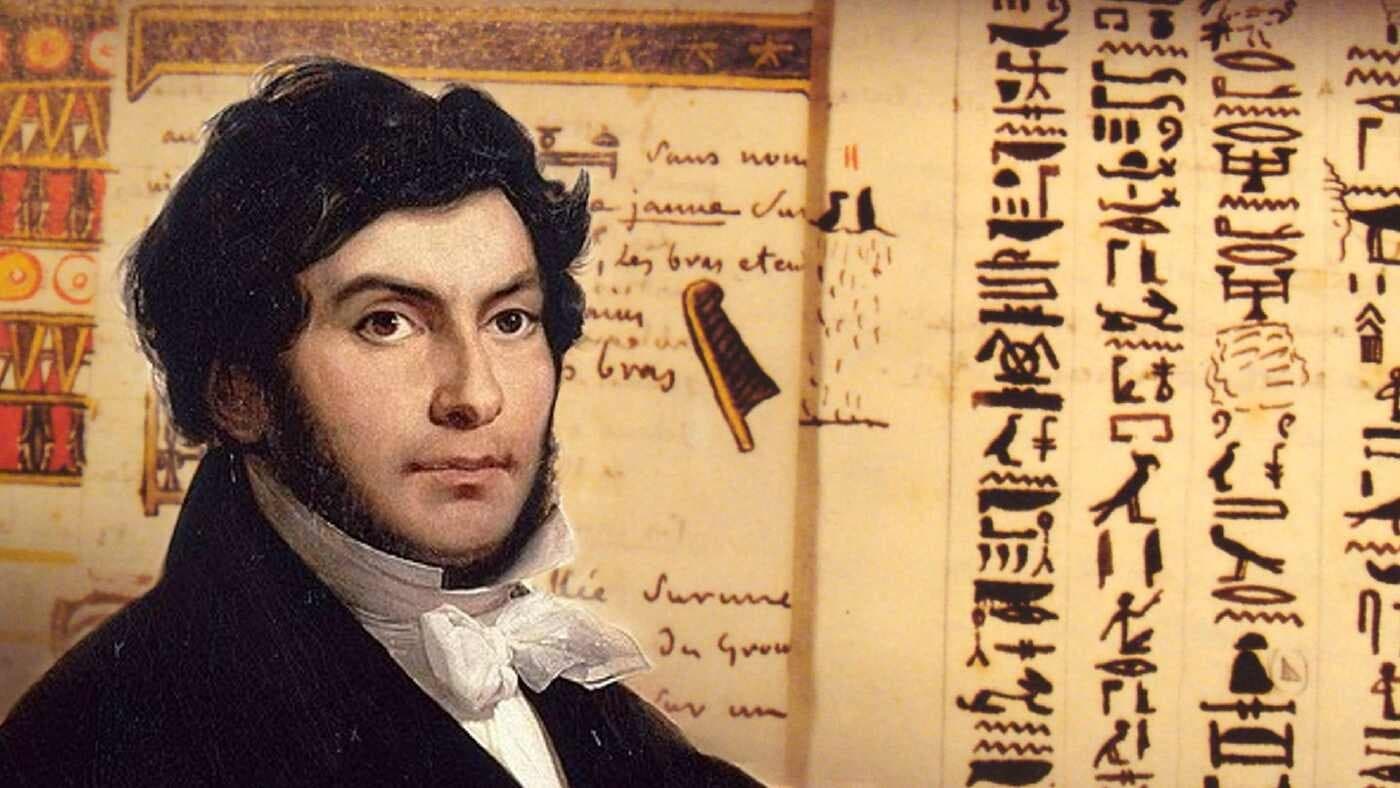
Discoverer of the Rosetta Stone
Without the work of the renowned French linguist Jean-Francois Champollion, nothing would be known about Egyptian mythology or religion today. Until Champollion cracked the code in 1822, there had been a 1,500-year loss of the capacity to read hieroglyphs. Because his father was a librarian, Champollion was surrounded by books written in a variety of languages as a child and showed an extraordinary aptitude for learning the language. He studied Latin, Greek, Arabic, Syriac, Chaldean, and Hebrew, but Coptic a language spoken in late-period Egypt proved to be the most useful for translating hieroglyphs. It is known as Coptic because the Copts were the Egyptian Christians who utilised the script, which is written in the Greek alphabet with seven additional unique letters.
Champollion first became obsessed with figuring out the significance of the ROSETTA stone in 1808, when he was still a youngster. He learned there were three distinct Egyptian writing systems: Hieroglyphic, which was used for pictorial writing; Demotic, which was employed later and was more cursive; and Hieratic, which was a cursive writing system used by priests. By comparing hieratic papyri with hieroglyphic and demotic writings, he came at this conclusion.

Champollion started comparing the Rosetta Stone's hieroglyphic writing to its Greek translation. The name PTOLEMY held the secret. It was well known that the pharaohs used oval symbols known as CARTOUCHES to write their names. The oval stood in for a rope, signifying the pharaoh's rule over everything the sun encircles. The name on a comparable cartouche in the hieroglyphic text had to be Ptolemy because the Greek inscription stated the name. With these letters established, Champollion moved on to additional names (Ptolmis was the Greco-Egyptian spelling of the name).
He knew the name Cleopatra from writing on an obelisk discovered on the island of Philae. A Greek inscription at the foot of the obelisk mentioned Cleopatra, therefore Champollion was aware that it was her name. The foundation for what we know now is Champollion's research on the hieroglyphic alphabet. While they had semi-vowels, which are sounds similar to modern vowels, the Egyptians did not use vowels. Also, during the most of their 3,000-year existence, they lacked signs for the consonants L and O, which occur in the names of Ptolemy and Cleopatra.
Champollion struggled with health issues during his long career studying hieroglyphs, and it was a struggle for him to travel to Egypt to continue his research. With his death in 1832 at the age of 41, a new set of academics started translating books and elucidating the mysticism of hieroglyphs.