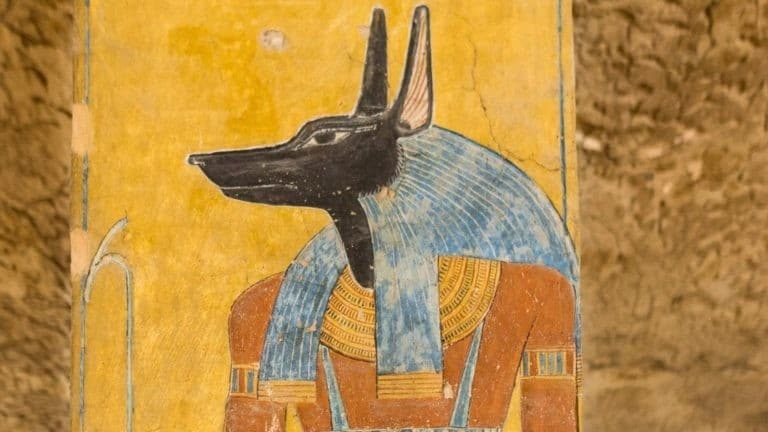
(ANUP) Anubis, the jackal deity of mummification and keeper of the cemetery, had three significant functions in the funeral rites. Originally, he served as the cemetery's watchman, frequently depicted as a jackal brandishing a flail or whip as a symbol of power. His collar was inscribed with mystical symbols.
Second, according to myth, OSIRIS' body was embalmed by Anubis, who also served as the god's bodyguard during and after the embalming. The mummy's preparation for its passage to the NETHERWORLD is Anubis' primary responsibility.
Finally, Anubis is the mummy's protector within the tomb. The Tutankhamen tomb has many iconic images of Anubis. In 1922, British Egyptologist Howard Carter discovered the storehouse of Tutankhamen's tomb to be filled with mystical things that the monarch would want in the afterlife. A magical reed torch with a brick support and a little hole in the centre for the reed was set between the paws of an Anubis statue facing west. The frightening spell was scratched on the block as follows:
"I am the one stopping the sand from engulfing the sacred chamber and stopping him from being repelled by the flames of the desert. The desert is on fire because to me.
I'm to blame for the wrong road. I support keeping Osiris safe".
Anubis was tasked with keeping watch over this space, which was formerly known as the Treasury of the Innermost. Anubis was seated atop a shrine with several compartments, each containing funeral items including two wooden amulets in the form of mummies and four blue faience forelegs of a bovine animal.
Family of Anubis

Many mythologies identify several gods as Anubis parents. One story states his mother was NEPHTHYS and his father was Osiris; in other tales, his father was SET. According to the Greek author Plutarch, Anubis is the child of Osiris and ISIS. Plutarch also mentioned that the dog (Anubis) is an excellent protector since he is vigilant both during the day and at night.
Anubis resided in the cemetery, and his primary responsibility was to oversee mummification and embalming. According to legend, Anubis mummified Osiris and had the sisters Isis and Nephthys weave exquisite linen wraps for his body. In tomb paintings, he is seen visiting a mummified body and declaring, "I have come to protect Osiris," since Osiris, the god of the dead, was connected to every mummified body. In other sequences, Anubis is shown giving the mummy's heart in order for the corpse to be complete when it enters the Netherworld. In genuine mummifications, Anubis was portrayed by a priest sporting a jackal-head mask.
A number of mythical writings make reference to Anubis. He appears in the vignettes or images in the BOOK OF THE DEAD as a participant in the weighing of the heart ritual in the Hall of the Two Truths. Anubis checks the mummy's heart against the scale to see if it is as light as the feather of truth; if it is, he will make the deceased eternal while THOTH waits to record the result. Anubis initially wraps the dead king's head in the BOOK OF CAVERNS, supporting and preserving the mummy's face with strips of linen. Anubis is responsible for preserving the corpse by adorning the mummy with scented incense and holy oils. The seven mystical embalming oils were also utilised in regular life. Festival perfume, Hekenu oil, Syrian balsam, Nechenem salve, anointing oil, best cedar oil, and best Libyan oil were some of the names given to them.
The many names of Anubis recognised his many functions as the deity of mummification:

- However, he is at the embalming location (guardian of embalming).
- Tepy-du-ef is standing on his hill (Anubis guarding the necropolis).
- Lord of the holy country Neb-ta-Djoser (the actual necropolis).
- The most prominent Westerner is Khanty-vimentin (first among the deceased).
- Khanty-she-netjer, the ruler of the god's hut (a symbol for the tent where mummification took place).
Anubis was revered under the time of the Greeks and subsequently the Romans in Egypt as a cosmic god who provided light to the populace. Anubis, who served as Osiris' protector, is shown on the walls of the tombs at Alexandria dressed as a Roman commander.
Anubis' appearance in the Procession of Isis was recounted by the poet Apuleius in second-century Rome as follows:
The Deities sent to walk on human feet immediately after these did so, with the first of them raising magnificently up high his dog's head and neck. This messenger between heaven and hell alternatively displayed a countenance as dark as night and as brilliant as day.
Anubis was nevertheless revered as a protector of the dead up to the advent of Christianity.