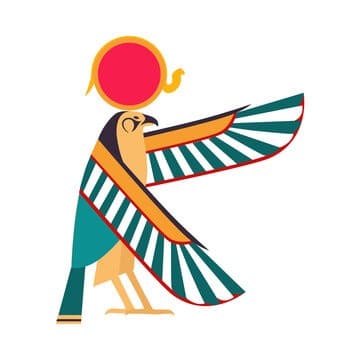
FALCON The falcon, or hawk, has maintained a special role in Egyptian mythology since the beginning of the country's recorded history. The falcon, soaring over the desert sky, was revered as the king's guardian and a representation of the sun deity. Re. One of the first places of worship for the falcon deity was located at Hierakonpolis (hawk city), where several significant findings have been unearthed. An ancient historical record from the area called the Narmer Palette (3100 B.C) depicts the falcon as monarch enslaving his opponents. The Egyptian faith has long held hawks in high regard.
They stood in for Montu and Sokar, the battle gods, and the goddess Hathor, who was occasionally shown as a female falcon. In his Histories, the Greek historian Herodotus reports that shooting a falcon resulted in death. The falcon is typically depicted with his wings spread in his capacity as the king's defender. The Fourth Dynasty statue of The well-preserved Ptolemaic temple at Edfu is defended by two enormous falcons carved from black granite serves as an illustration of this. They guard the king's likeness.

A falcon-like figure is shown behind King Chephren (Khafre), its wings spread. The flight of a falcon as it ascends to heaven is compared in the Pyramid Texts to that of the king's soul. Hawks were sacrificed to the falcon deity Horus during the Late era (747-332 B.C) and then mummified and buried in a catacomb at Saqqara. In ancient Egypt, animal mummification was a lucrative industry, and it appears that a sizable portion of it was false. From bulls to doves, the ancient Egyptians mummified a wide variety of animals for a variety of reasons. Several were reared to be sacrificed as sacrifices to the gods, while some were pets saved to keep their owners company in the afterlife.
An Egyptian may place a gift of a mummified animal in the temple of a deity to ask for a favour. The ibis and falcon galleries of Saqqara, kilometres of tunnels filled with mummified birds, are Egypt's greatest animal graveyard. There are hundreds of niches with a mummified bird in a clay pot carved into the walls of each tunnel. The priest piled the pots on the floor when he ran out of niches to place them in. Both the falcon and the ibis were considered sacred by Thoth. There were shops where pilgrims could buy mummified birds, many of which had been grown for that purpose, along the path to the galleries. One was chosen by the pilgrim, put in a pottery pot, and then sealed. For a modest price, gallery priests would set it in a niche and offer a prayer for the traveller. Hor, a monk who oversaw the ibis galleries about 200 B.C, said that Saqqara employed hundreds of workers in the animal mummification industry.
Doorkeeper was one of the more significant positions. According to Hor, the doorman likely raised the ibises since he watched over the birds, who are still young. Falcons, unlike ibises, cannot be reared in captivity, hence there were insufficient amounts of falcon mummies to satisfy the demand. Suppliers then started to create fake mummies. Falcon mummies are usually invariably old fakes created from a bundle of rags with lovely wrappings on the exterior, according to X-rays of falcon mummies. Hor expressed his worry in his writings that the pilgrims were being taken advantage of when they bought a falcon mummified as a sacrifice. He stated that there must be one deity or a bird in each clay pot.
In conclusion, the falcon was a well-known and highly respected symbol of royal power and divine protection in ancient Egypt. This magnificent bird was incorporated into the religious rituals, art, and writings of the ancient Egyptians, deeply influencing their spiritual and cultural fabric. Egypt tours provide a window into the symbolism and significance of the falcon as well as other aspects of ancient Egyptian culture allowing tourists to experience the rich legacy of this civilization. Egypt travel packages accommodate a variety of interests from Luxor temple exploration to Nile cruising to marveling at the Giza pyramids. Egypt luxury tours are available for those seeking opulent experiences, and Egypt Easter tours or Egypt Christmas tours combine exploration with other activities.