Dreams and Their Meaning in Ancient Egypt

Dreams, according to the ancient Egyptians, were like oracles that brought messages from the gods. It is clear how significant dreams were in ancient times from the regularity with which they are referenced in the first two books of the Old Testament. There are more than a dozen allusions to dreams in Genesis alone, the most of which are prophetic.
The Old Testament tale of Joseph and his brothers reveals a lot about prehistoric attitudes on dream prophecy. In part because of visions he had predicting he would reign over his siblings, Joseph was sold into slavery (35:5 - 11). Two of the previous pharaoh's officials, a cupbearer, and a baker later revealed to Joseph that they had experienced dreams but were unable to comprehend them while he was imprisoned in Egypt. The cupbearer would be released and the baker would be executed in three days, as Joseph accurately deduced from the dreams. When Joseph was asked to explain the pharaoh's dreams that the royal magicians had been unable to understand, he was freed from jail. The pharaoh had first witnessed seven fat cows being eaten by seven skinny cows.
In the second dream of the pharaoh, seven small ears of grain were eaten by seven large ones. Egypt will experience seven years of prosperity followed by seven years of famine, according to Joseph's interpretation of the dreams, and the populace would need to make enough preparations to prevent widespread hunger. We can also learn about the Egyptians' belief in prophetic dreams from archaeological data. The most well-known example is possibly that of Thutmose IV (1400–1390 B.C). A stele that describes a dream had by the young prince who would become Thutmose IV may be found near the base of the Great Sphinx.
The Great Sphinx was partially covered in the sand when the prince took a midday snooze while out hunting in the desert. The young prince had a dream that the Sphinx had informed him that if he removed the sand covering it, he would become pharaoh. He made himself pharaoh after removing the sand from the Sphinx. The stele confirms that the ancient Egyptians had a significant belief in prophetic dreams, which is implied in Genesis and Exodus. In the Joseph narrative, the pharaoh trusted Joseph's interpretation of his visions sufficiently to give him responsibility for the nation's economic future for the following 14 years.
The Egyptian Dream Book

The British Museum's nearly complete Hieratic Dream Book provides some insight into how the ancient Egyptians understood dreams. Although being written on the papyrus recto side (front), several portions of the book have been lost. The letter to the vizier of Egypt is reproduced on the verso (behind), the side with the horizontal fibres on top (also the side that is easier to write on), and it depicts a war. There is no question that the Nineteenth Dynasty was used to write this website (1295 - 1186 B.C). The Dream Book was undoubtedly written later because the verso, or rear side, is usually written first. This Dream Book edition could have been a copy of an older papyrus from the Twelfth Dynasty (1985 - 1795 B.C).
The start and the end of the papyrus are damaged, as is so common with this material. The list of dreams and their explanations is all that is left. Who the papyrus was meant for is a mystery. One theory is that since the average person could not read, the priests' duties included dream interpretation. This would be in line with biblical tales in which only a select few people had the capacity to interpret dreams. The House of Life's priests may have served as the translators, according to hieroglyphs. The closest we come to vocalised ancient Egyptians is through Coptic writing, which is ancient Egyptian written in Greek letters with a few extra characters. When the PHA rash requests the help of his dream interpreters, the Coptic (Bohairic) translation of the Bible uses the term seshperonch.
The name sesh-per-ankh scribe of the House of Life is possibly a corruption of this. Anybody seeking divine direction would often spend the night at the temple, where the priests would then interpret their dreams for a charge. Each Greek visitor to Egypt was almost expected to spend the night in a temple to receive dream oracles, and the Temple of Seti at Abydos was a favourite. The names of visitors who stayed there are engraved into the walls of the temple's back stairway. It appears that at least some of these passengers spent the late hours of the night carving their names because the names are frequently barely a foot or two above the stairs. One group recorded, that they caught a fox here. The Dream Book is arranged in an orderly way, from right to left, and was written in hieratic, a cursive variant of hieroglyphs. If a guy sees himself in a dream, it says in the right margin. Each horizontal line begins with a dream description and ends with the dream's interpretation. Each interpretation starts with Good or Poor and then provides an explanation. A partial listing of the Dream Book's interpretations may be seen below.
Dream: Prediction kill an ox well. It denotes the expulsion of the dreamer's adversaries. Writing about Well. It indicates that the status of the palette dreamer is generally known. Blood is Wonderful to Drink. It entails eliminating his adversaries. choosing dates Well. It entails locating food provided by a god. A big cat sighting is pleasant. It portends a plentiful harvest for the dreamer. partnering with evil. It entails living like a pig without any things. Finding his Bad. It implies that later on, the dreamer's behind will end up alone. Getting up well. It entails being a mast held high by a deity. It's good to drink wine. It means something female slave from which he will have satisfaction.
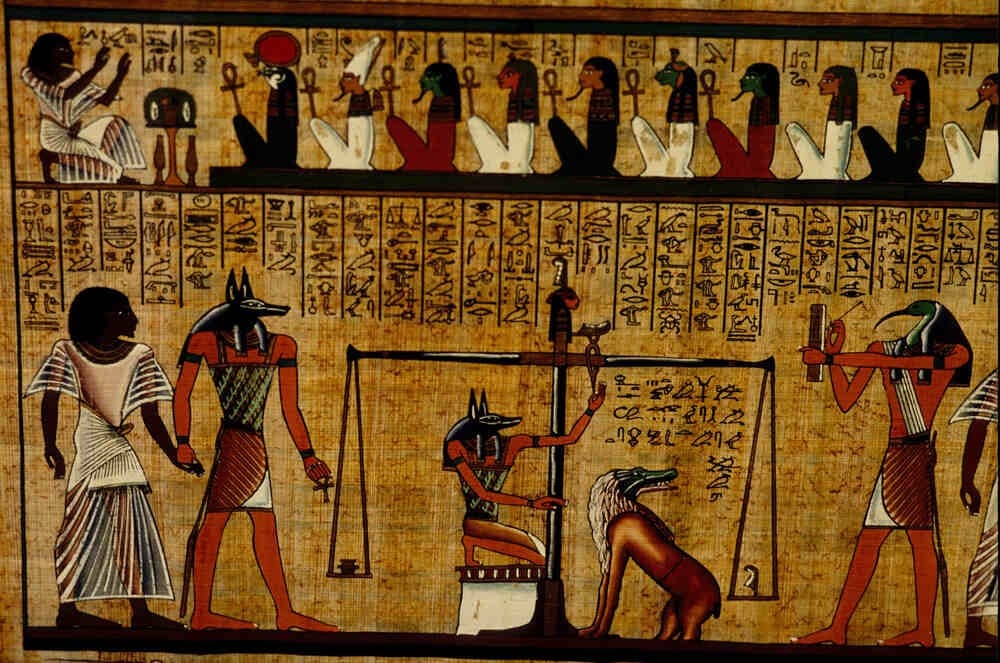
There doesn't appear to be a recurring theme or method used to interpret the dreams. It's possible that the list was collected over many years with evolving meanings. DUAMUTEF One of Horus' four sons who was in charge of protecting the mummy's internal organs. The stomach was protected with Duamutef. Duamutef has a jackal-like head. DUAT The Duat was a mythical area between the world of the living and the world of the dead, a land of darkness and home to fearsome monsters.
The Duat is said to be situated deep within a valley that divides Earth from the Netherworld, according to the Amduat, The Book of That Which Is in the Netherworld. The spirits of the dead go with Re the sun god as he descends below the horizon at the end of each day to start the 12-hour trip. Only those souls that pass the Weighing of the Heart Ritual and are determined to be pure are permitted to go with the sun god on this deadly voyage. The wicked demons who threaten the sun god at every hour are defeated at the conclusion of the twelfth hour, and Re and the souls successfully make their way into the welcome domain of the sky goddess Nut. The souls get ready for their ascension in the Netherworld as He arrives on the horizon to usher in a new day.
Conclusion
Dreams had great meaning in ancient Egypt where they were viewed as gateways to the divine and woven into the fabric of daily existence. The dream world was seen by the Egyptians as an intervention from the gods offering legal counsel for the present as well as insights into the future. Understanding dreams was important to priests and scribes who carefully documented dreams in hieroglyphics. Decisions about everything from royal orders to agricultural techniques were frequently strongly influenced by these visions. Dreaming rituals and incubate rites were used by people as sanctuaries in temples to seek divine contact and dreams were also an essential part of spiritual activities. Dreams remained important aspects even after death as the departed passed into a dream world on their way to the afterlife.
Travelers nowadays are frequently enthralled by the residual vestiges of this antiquated belief in dreams when they set out on Egypt tours, seeing ancient treasures and solving historical puzzles. Egypt travel packages provide the chance to experience the rich tapestry of Egyptian mythology and spirituality in addition to seeing the architectural wonders of the pyramids and temples. Egypt Luxury tours provide luxurious experiences amid the eternal landscapes of the Nile where dreams once flowed like the river's waters for those looking for a little more luxury. Egypt Nile cruise go back to the romanticism of bygone eras of travel as passengers are invited to navigate the same legendary waterways that fed the imaginations of both ordinary people and pharaohs. Whether they are Egypt Christmas tours or Egypt Easter tours travelers can delve into the ancient wisdom that revered dreams as portals to the divine enriching their journey with echoes of a mystical past.