The Most Sacred City in Egypt
On the West Bank of the Nile, not far from contemporary Sohag, is the most sacred city in all of Egypt. In ancient Egypt, the site to be buried was Abydos (also known as Ibdju), which served as the primary ritual center for Osiris, the god of the dead. The Egyptians recognised the burial site of Osiris as the tomb of King Djer, the third pharaoh of the first dynasty (c. 3000 BC). One of Egypt's most exquisite temples, which Seti I constructed during the New Kingdom, is still regarded as a national treasure.
From pre-dynastic to Christian eras (about 4000 BC - AD 600), Abydos was continuously utilised as a necropolis for more than 4500 years. The site hasn't been excavated in many areas.
The story states that Osiris's corpse was divided into parts and dispersed throughout Egypt, and that his head or according to other accounts, his phallus was buried in Abydos.
The Pre-dynastic and Early Dynastic kings of Egypt's tombs are the oldest structures in Abydos. The earliest pharaohs were buried in Abydos and hailed from a neighboring settlement. The temple of Osiris-Khentimentiu, dedicated to an ancient jackal god linked with Osiris-Khentimentiu meaning first among the westerners (the west being designated for the dead), and emphasises Osiris's function as the first among the living. These are the earliest ruins still standing today.

Early dynasty royal tombs as well as a number of wooden boats have been found during excavations. Djer, a mud-brick tomb of the First Dynasty ruler, was formerly believed to be Osiris's grave. This could have helped the religion of Osiris become more well-known. The OSIREION chapel, which was built out of massive granite blocks and is said to be Osiris's fictitious tomb or cenotaph, is the most spectacular monument to him in Abydos. People visited Abydos on pilgrimages throughout the Middle Kingdom (2055 - 1650 B.C), and many of them left steles offering tablets for Osiris inscribed with their names and prayers.
The mortuary temple of Seti I was constructed mostly of limestone, with sporadic usage of sandstone in various locations throughout the edifice, and has a distinctive L-shaped ground plan. After Seti I passed away, his son Ramesses II finished the temple. Ramesses II's cartouches may be seen in several areas of the temple, along with his distinctive sunk relief style, which contrasts with his father's extremely beautiful raised relief.
The Osiris chapel
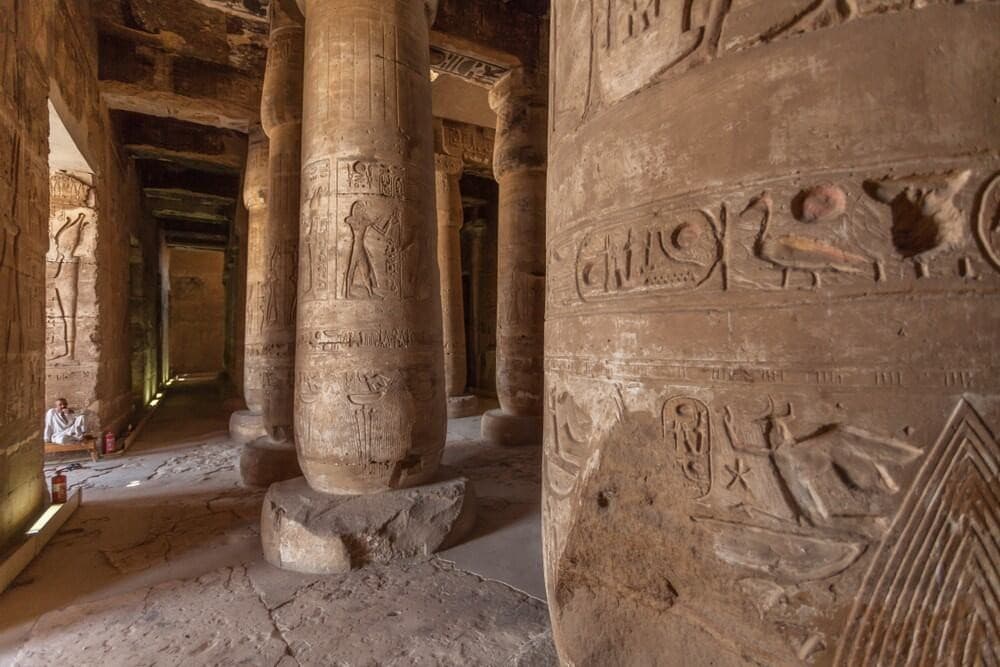
The temple's northeast entrance is through a huge pylon that has since been demolished, and it leads onto the first open court, which has likewise suffered significant damage. The second court is accessible by three entrances at the back of the pillared hall from a raised terrace reached through a staircase ramp on the temple's principal axis. Ramesses II adorned the courtyards with representations of the Battle of Kadesh and the King making a gift to the Gods. To reach the elevated terrace with the covered portion of the temple, use another stairway ramp. Seven gates, all except the central one of which were shut by Ramesses II, constitute the front and entrance to the first hypostyle hall. The portico is supported by pillars. Twelve pairs of sandstone papyrus columns with blossom capitals decorate the hall. The second hypostyle hall, which has 36 columns similar to those in the first hypostyle hall, is accessible by another seven gates. Seti I is seen bending down before the gods in the elegantly furnished hall.

Seven chapels honouring the gods Seti I (in his deified form), Ptah, Re-Hor-Akhty, Amun-Re, Osiris, Isis, and Horus may be found in the second hypostyle hall. These shrines were probably among the first parts of the temple to be adorned, and based on their stage of completion, they were probably finished before Seti I passed away. These chapels are adorned with representations of the king making a sacrifice to the gods and receiving from them symbols of dominance and life as well as regal insignia. The ceremonies that priests would have carried out behind the chapels' walls to change the monarch into the deity of death and resurrection, Osiris, would have complimented these displays.
The Osiris chapel opens up onto a transverse Osiris-cult complex with two halls and two sets of chapels. The gods Osiris, Isis, and their son Horus are honoured in the three little chapels to their right of the entrance hall. In the religion of the ancient Egyptians, the monarch who was alive symbolised Horus on earth, and after his death, he changed into Osiris, king of the underworld. The mysteries of Osiris were performed in the hidden room with two pillars behind these three chapels, which could only be entered by the top priests.
Other chapels can be seen in the southern portion of the temple, including those dedicated to the gods Ptah-Sokar and Nefertem, as well as the unfinished "Hall of the Butchers" and "Hall of the Barques" (where the barks that carried the gods' statues during rituals were maintained) (the temple slaughterhouse). There is also a part here known as the "Gallery of the Ancestors," which houses the well-known Abydos King List. It is assumed that this is where the rites of the temple would have begun. The little chapel of Osiris was then reached after a procession of priests had passed through the other six chapels. By the rites, Seti I, the deceased monarch, was changed into the deity Osiris, with whom the dead Egyptian rulers were associated.