Funerary texts: The prayers, charms, and incantations included in funerary writings are meant to guide the dead to the afterlife. The first funerary manuscripts, known as Pyramid Texts, were from the Old Kingdom (2686 - 2181 B.C). The Pyramid Texts, which were carved on the walls of the burial chamber of the Fifth Dynasty King Unas' pyramid (about 2345 B.C), are the first significant collection of written Egyptian writings. They convey a well-developed concept of the afterlife.

The Pyramid Texts give advice like "cast the sand from your face" because they are primarily concerned with the protection of the king's body. The monarch in some passages seeks to intimidate the gods into adopting him as one of them. Eight subsequent pyramids from the Sixth through the Ninth Dynasties include copies of the Pyramid Texts, totaling over 800 spells (2345 - 2125 B.C). Not all spells were included in every pyramid, and the spells don't appear in any particular sequence. Funerary customs were no longer exclusive to royalty and the affluent throughout the Middle Kingdom (2055 - 1650 B.C).
Now, regular folks may also enjoy a respectable funeral and a life after death. New religious writings were required as a result of this evolution. The Coffin Texts were developed from the Pyramid Texts. The Coffin Texts, also known as the Book of Two Paths, were used to direct the departed on their journey to the afterlife. On the common wooden coffins of the time, they were carved in vertical rows. One of the Coffin Texts' improvements was the removal of the sun deity as the highest being. Because the deceased were doomed to spend forever with Osiris, the god of the Underworld, he became the protector of the dead.
Ancient Egyptian Texts
The concept of the Field of Reeds was also created by the Coffin Texts, where the dead would labour in the fields for an arbitrary period of time by plough, sow, and harvest. At this point, the concept of a magical replacement worker was first proposed. Ushabtis, mummiform statuettes with mystical charms to activate them, would carry out the necessary agricultural activities for the departed. The Book of the Dead, a New Kingdom (1550-1069 B.C) invention that continued to aid the departed on their trip to the next world, replaced texts that had grown to be too numerous to inscribe on coffins. Almost half of the magical spells included in the Book of the Dead were taken from the Pyramid Texts and Coffin Texts.

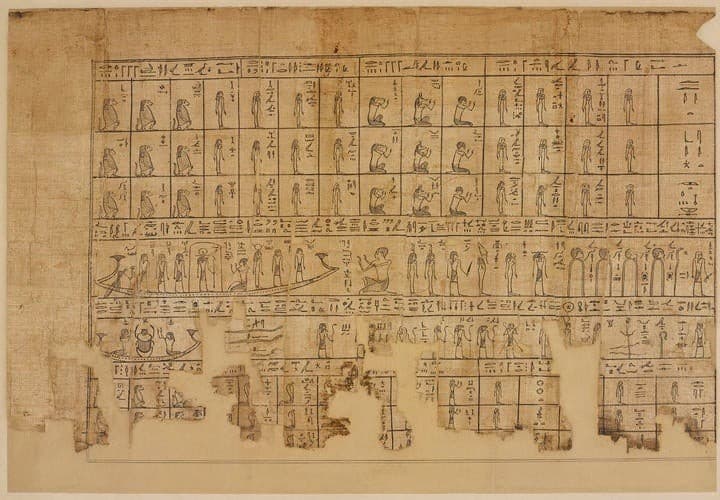
They contain a number of vignettes that serve as chapter illustrations. The ability to simply write on papyrus and copy the Book of the Dead was one of its advantages. The Book of the Dead had no set structure because it evolved from a number of prior texts, and chapters were occasionally duplicated incorrectly or twice. The Book of the Dead eventually appeared in several editions, but each one always contained the most significant chapters.
The Book of the Netherworld is the current name given to a subsequent collection of disparate books that were partly drawn from the Book of the Dead. These books are religious essays that describe the sun god's trip through the realm of darkness every night in step-by-step detail, in contrast to the Book of the Dead, which is a collection of magical spells, prayers, and incantations. They also discuss the Beyond World. The Amduat, the Book of Caverns, the Book of the Ground, and the Book of Gates were among the Books of the Netherworld.