Throughout the Predynastic period of Egyptian history to Christian times, Abydos, the most sacred city in Ancient Egypt, served as a centre for religious activities. It was near to modern-day Sohag on the West Bank of the Nile. Towards the conclusion of the Old Kingdom, Abydos was the first and most important centre of devotion when OSIRIS gained popularity. Osiris's body was allegedly divided into pieces and dispersed over Egypt. According to legend, Abydos is where Osiris's head was interred.
The Predynastic and Early Dynastic kings of Egypt's tombs are the oldest structures in Abydos. The first pharaohs were buried at Abydos and came from a nearby village, the location of which needs to be clarified. The earliest remnants still standing today come from the Osiris-Khentimentiu temple, which was built to honor a jackal god who was once connected to Osiris. Osiris's function as a benevolent burial god is emphasized by the name Khentimentiu, which translates to "foremost of the westerners" (the west was reserved for the dead).
Early Dynastic royal tombs, as well as several wooden boats, have been found during excavations. Ancient Egyptians believed that the mud-brick tomb of the First Dynasty ruler Djer contained the remains of Osiris. This might have helped the cult of Osiris become more well-known. The OSIREION is a chapel made of enormous granite blocks that are thought to be Osiris' fictitious tomb or cenotaph and is the most spectacular monument to him in Abydos. People visited Abydos on pilgrimages throughout the Middle Kingdom (2055 - 1650 B.C), and many left STELE, or offering tablets, for Osiris inscribed with their names and prayers.
The "mysteries," which were passionate dramas based on the biography of Osiris, were centered in Abydos. Abydos developed into a holy site with both literal and metaphorical significance. The congregation lit lamps to symbolize Isis's hunt for her husband's body parts as a chorus sang prayers. Osiris was the first mummy and was thought to have been the first to rise from the dead. He ascended to the position of the monarch over the NETHERWORLD, to which only Osiris had access. Osiris was a fertility deity and the god of the dead. He is frequently depicted as a mummy in tomb paintings with green skin and arms folded over his chest. The symbol of Osiris at Abydos that you will see during your Egypt tourswas a pole covered with animal skin and two plumes, which was also associated with ANUBIS.
Peribsen and Khasekhemwy, rulers of the Second Dynasty, built their tombs in Abydos to be close to Osiris' last resting place.
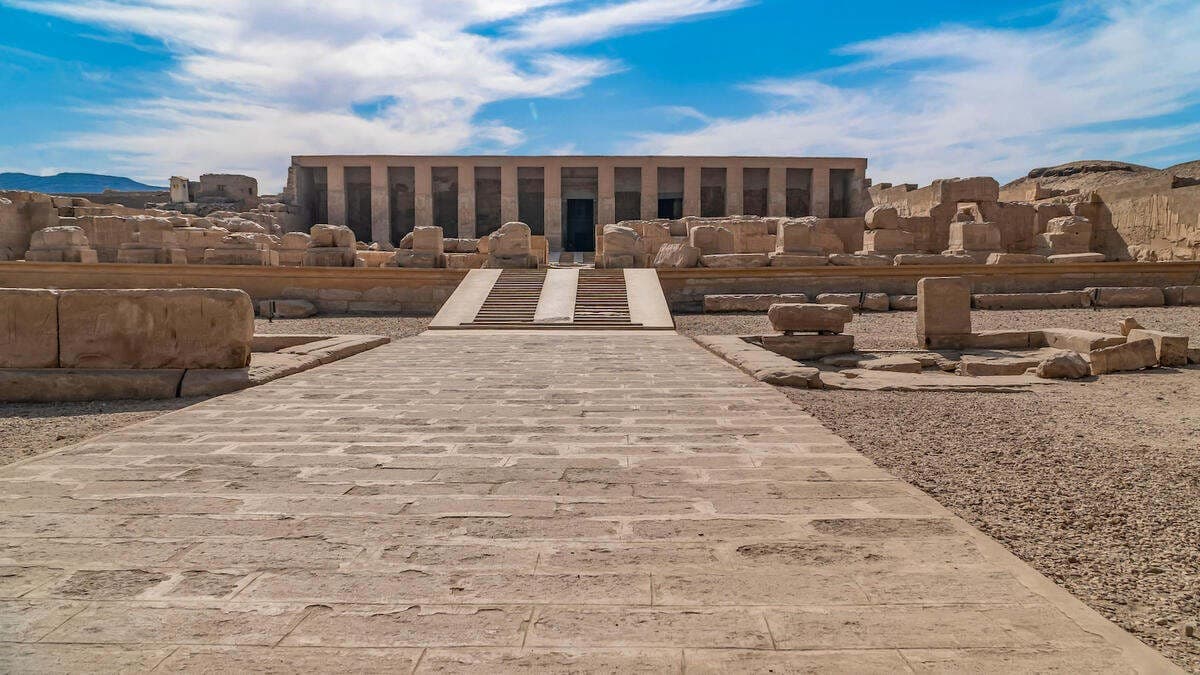
Today, the TEMPLE OF SETI, the father of Ramses II, is considered to be Abydos' most crucial structure. The carvings and colors in the temple of Seti I, the first pharaoh of the Nineteenth Dynasty, are unparalleled in any other Egyptian temple (1295 - 1186 B.C). Visitors can examine the old religious rituals depicted on the walls of the seven chapels because it has been maintained so beautifully.
Since there are no towers in front of the temple, one must enter through the wide staircase. Seven aisles within lead to seven chapels, each devoted to a different divinity, among them Seti I. A carving of Seti I and the god to whom that chapel is dedicated may be found at the entrance to each chapel. The third building on the right is the Chapel of Osiris, where one may observe the king performing traditional Osiris Cult rituals. Seti is portrayed as the acting high priest who is anointed with holy oil. Seti enters the shrine wearing a plain kilt and carrying an oil lamp and an incense pipe to light the hallowed gloom of the cover. The king, chanting prayers, approaches the shrine of Osiris; he unbolts the doors of the holy shrine; the god, in the form of a cult statue, is greeted with morning hymns and offered food and wine, and incense is burned. The figure of the god is anointed with precious oil and dressed in the finest linen. More prayers are offered, and god is returned to An aegis, a small shield. For the Egyptians, the aegis was sign of protection, and they often decorated the prows of their boats with it.
His shrine. The king withdraws, bowing, and sweeps away his footprints. This ritual is repeated in each of the other six chapels that are dedicated to HoRus, Isis (wife of Osiris and mother of Horus), AMUN-RE (the great god of Thebes), RE-HORAKHTY (Horus of the Horizon), PTAH (the creator god), and Seti I. In the chapel of Seti I, the king performs the ceremonies in front of a cult statue of himself.